
Climate & Storm · 7 min read
Pine Pollen Season on the Northshore: Protecting Your Condenser Coils
By HVAC Covington LA · Published March 4, 2025 · Updated June 16, 2025
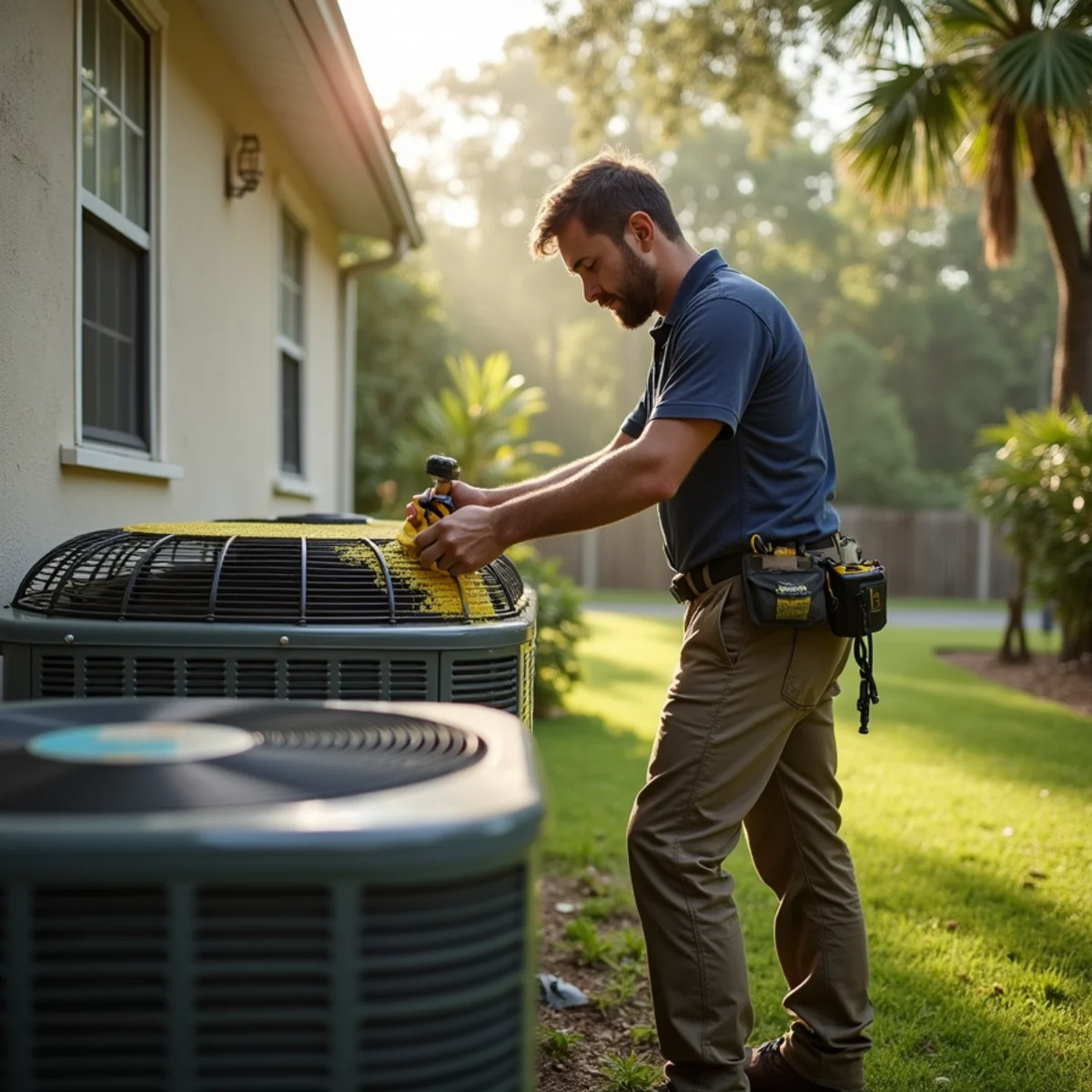
Anyone who has lived through a Northshore spring in Sun or Bush knows the yellow-green dusting that coats cars, porches, and everything else for weeks. That pine pollen does not just make you sneeze, it packs into the fins of your outdoor AC condenser and quietly chokes its ability to cool your home.
A condenser works by blowing air across its coil to dump heat outside. When pollen mats down over those fins, airflow drops, the system cannot shed heat, and it runs longer and hotter to keep up, right as our cooling season is ramping up.
Here is why pollen is so hard on Northshore coils, how to spot the problem, and the safe way to clean it without wrecking the fins.
How pollen chokes a condenser
The outdoor coil is a dense grid of thin aluminum fins wrapped around copper tubing, and the whole point is to let air pass through freely. Pine pollen is fine and sticky, and it settles into those fins like lint in a dryer screen. As it builds, the coil can no longer breathe.
The result is a system that works harder for less cooling. Longer runtimes, higher power bills, weaker cold air, and extra strain on the compressor all follow from a coil that cannot get enough airflow.
Signs your coil is clogged with pollen
- A visible yellow-green coating packed into the outdoor fins
- Weaker cooling and longer run times in spring and early summer
- The outdoor unit running hot to the touch
- Rising energy bills as pollen season peaks
- In bad cases, the system tripping off on high pressure
The right way to clean the coil
The safe method is simple but easy to get wrong. First, cut power to the outdoor unit at the disconnect or breaker. Then rinse the coil with a gentle stream of water from the inside out, so you push pollen back the way it came rather than driving it deeper into the fins.
Never use a pressure washer. The fins are delicate and a high-pressure stream bends and flattens them, which permanently reduces airflow, the exact opposite of what you want. If the fins are already matted or bent, a technician can straighten and deep-clean them properly.
- Turn off power at the disconnect first
- Rinse gently from the inside out
- No pressure washers, ever
- Keep shrubs and grass clippings clear of the unit
Staying ahead of pollen season
Because our pollen season is heavy and long, one cleaning is not always enough. Rinsing the coil every few weeks through the peak, and keeping the area around the condenser clear, keeps airflow up when your system needs it most. A pleated air filter changed on schedule also keeps pollen that gets indoors from loading up the evaporator coil.
A spring tune-up is the ideal time to get a professional coil cleaning and fin inspection right as pollen ramps up, so you enter summer with a coil that can actually breathe.
When to call for help
If your cooling is weak despite a clean-looking coil, if the fins are badly bent, or if the system is tripping off, the pollen may be masking a deeper issue like low airflow or a refrigerant problem. A maintenance visit sorts it out. To schedule a spring coil cleaning and tune-up before pollen season buries your condenser, call (327) 210-5999.
Why Northshore Pine Pollen Is Uniquely Hard on Your Condenser
The dense loblolly and slash pines that make the Northshore beautiful also blanket everything in a thick yellow-green pollen every spring, and your outdoor condenser acts like a giant air filter pulling that pollen straight into the coil fins. Unlike fine dust that blows through, pine pollen is sticky and clumps, matting into the aluminum fins and forming an insulating layer that chokes the heat exchange your AC depends on. The result is a system that runs longer, cools less, and drives your electric bill up right as Covington's heat is climbing.
What makes pollen worse than ordinary grime is that it combines with condensation and dust to form a paste that ordinary rain won't wash off. Left in place through summer, it corrodes the fins and traps moisture against the coil, shortening the equipment's life. That's why a proper spring coil cleaning on the Northshore isn't a luxury, it's the maintenance step that keeps your condenser breathing during the exact months you need it most.
How to Keep Pollen From Killing Your Condenser This Spring
A little diligence during pollen season protects both efficiency and the lifespan of your outdoor unit.
- Rinse the condenser fins gently with a garden hose from the inside out, monthly during peak pollen
- Never use a pressure washer, which bends the delicate fins and does more harm than the pollen
- Keep the top of the unit clear of pine needles and seed pods that block airflow
- Change your indoor air filter more often in spring, every 30 days instead of 60 to 90
- Keep shrubs and vegetation trimmed two feet back so air moves freely around the unit
- Consider a spring professional coil cleaning that flushes matted pollen the hose can't reach
- Watch for longer run times or weaker airflow as early signs the coil is clogging
Frequently Asked Questions
Yes. Fine, sticky pollen packs into the condenser fins and blocks the airflow the coil needs to shed heat. That means longer runtimes, higher bills, weaker cooling, and extra compressor strain, and in bad cases the system trips off on high pressure.
Services Mentioned
Related Reading
Troubleshooting
Why Condenser Coils Corrode Faster Near Lake Pontchartrain
Homes near Lake Pontchartrain lose condenser coils to corrosion years before inland homes. Here is why the lake air is so hard on your AC and how to fight back.
Seasonal Maintenance
Spring AC Tune-Up Checklist for Covington, LA Homeowners
What a real spring AC tune-up covers on the Northshore, why pine pollen and humidity make it non-negotiable, and the checks you can do yourself before we arrive.
Seasonal Maintenance
How Often to Change AC Filters in Humid South Louisiana
Why the standard 90-day filter rule falls apart in South Louisiana, how to pick the right MERV rating for a humid climate, and the signs your filter is overdue.